Friday, March 22, 2024

Analysis of Electric Vehicles (EVs) vs. Internal Combustion Engines (ICEs) and Insights from Revel CEO Frank Reig


As someone who has always been obsessed with the economics and science behind electric vehicles, I have been following rideshare startup Revel since coming into college. Like other electric transportation startups like Lime and Bird, Revel’s goal is to help electrify transportation in major cities in the United States. While electric vehicle startups have notably struggled over the past year due to fundraising problems, higher interest rates, and quality issues, Revel has been doing really well as it has raised about $272 million in debt and equity financing since its inception, according to Pitchbook. After hearing CEO Frank Reig speak at a club meeting, I think it would be worthwhile to write an article about what he had to say about Revel and an analysis of the automotive landscape, with an emphasis on the headwinds and tailwinds electric vehicles face.   

Passenger Vehicles and Electric Vehicles in Cities 


To start, it is important to understand electric vehicles compared to internal combustion engine (ICE) cars on a basic level. For most electric vehicles, the motor runs on a lithium-ion battery because it has the highest energy density for weight as well as being able to charge faster and longer compared to other materials like cobalt -- not going to get too much into the science of how the battery works. With that being said, the range of an electric vehicle is not as long as an ICE, especially when you factor in cold temperature levels that limit the battery’s range even further. This is one of the biggest reasons why major automotive companies like Toyota have been able to succeed with its hybrid electric cars as customers are hesitant to buy EVs due to limited range concerns. Though when talking about the efficiency of energy usage between EVs and ICEs, EVs are a lot better. When stationary, an EV does not need to consume energy and is able to also offer regenerative braking to increase fuel efficiency. In addition, electric vehicles are ideal for those who want a quiet vehicle to drive in. 


Finally, the big question that you are probably wondering and may already be considering as a buyer of one: which costs less? To answer this simply, it really depends on a wide range of factors, which a study that was published in the Journal of Industrial Ecology actually explores. For EVs, the battery is the largest upfront cost that comes with purchasing an EV, which is why ICE cars tend to be cheaper; through economies of scale, these EV battery prices should drop. In addition, it depends where the consumer is located and how he or she is charging the EV. For a city like Detroit, car insurance costs are extremely high, with them being at an average of $5,687 for annual coverage; this does not even take into account the 20% premium that EV owners must pay for insurance relative to an ICE owner due to higher purchasing cost and repair. In this scenario, it does not make economical sense to buy an EV, especially if located in an area of Detroit that does not provide lots of cheap charging. In addition, for someone who has the capability to build out home EV charging, the study reported lower lifetime charging costs of up to $26,000. Coupling that with being in a city that also offers low overnight charging rates should provide another tailwind for choosing an EV. Finally, there are the regulatory incentives for purchasing an EV that may help slightly decrease the cost of ownership, with the $7,500 EV credit from the IRA being the most well-known -- the number of EV models that apply for this tax credit has decreased over time, with it being about 18 now. While I can keep on going on and talk even more about the differences between ICEs and EVs, this is just a surface-level comparison of how to compare the two. 


For large metropolitan areas that are trying to spur EV adoption like San Francisco and New York City, there are various things consumers consider that affect this, with what I may have mentioned already. For one, many consumers may see driving an EV in a city as more fuel efficient in a city, especially with the fact that there is regenerative braking (lots of stop-and-go traffic) and that energy is not being lost due to friction and heat as opposed to an ICE. In addition, EVs help with keeping city air cleaner and can be a quieter option for those who do want to contribute to the noise pollution that highly dense cities bring. While I am only familiar with NYC emissions law called Local Law 145 passed back in 2013, I would assume that other cities or states have similar laws in place and that more stringent measures could help with EV adoption. However, there is still a charging dilemma where even if there are enough accessible chargers to the public at a cost-effective rate in cities, the chargers may just be extremely slow. For example, there are three levels of charging speeds: level 1, level 2, and level 3. Below is one of the best infographics to explain the differences. 
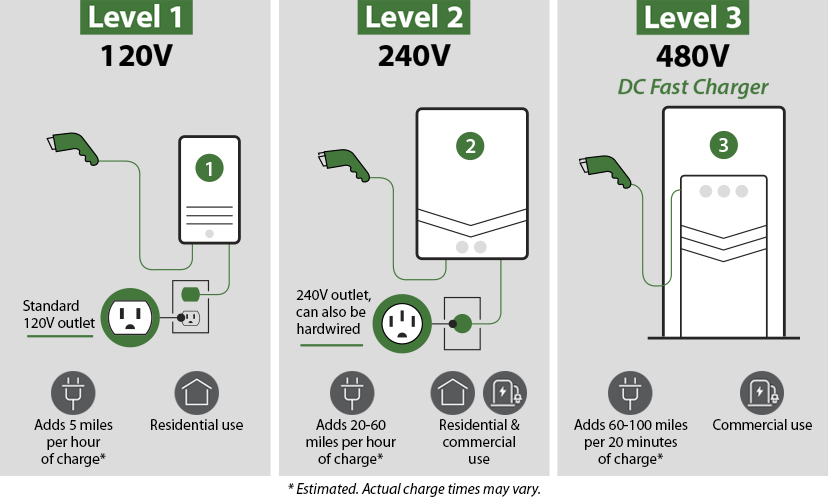
Level 1 chargers are included with EVs upon purchase, but can basically be rendered useless unless one has a hybrid car, at least in my point of view. Level 2 chargers are more practical for EV owners and cities like New York City have curbside Level 2 charging on public streets. Finally, level 3 or DC charging is the fastest type of charging, with its ability to charge an EV in under an hour. Other startups like Gravity have opened even faster charging, with it recently creating 24 EV charger systems in New York City, charging an EV 200 miles in five minutes. However, one problem with creating a citywide fast charging network is that you must create stations that have the different types of EV charging plugs; Level 3 plugs are not standardized for all EVS unlike the lower-level chargers. As an example, Hyundai IONIQ 5 and Kia EV6 are examples of cars that are unable to connect to Tesla Level 3 superchargers. In addition, the buildout of charging in garages in cities for individuals can prove to be difficult. If someone is at home or at the office, he or she wants to make sure the EV is charging while away. For families that live in a private residence, this is no problem. However, for others living in apartment complexes in Manhattan or driving in to work, it may be difficult. Private garages tend to be expensive with the parking fees and then some of the chargers may not have regular maintenance on them. It is far easier to install the charging during the construction of new garages or parking and even if the infrastructure is installed, this will cause finding parking a lot more difficult unless Level 3 chargers are all being installed at these sites. These are a few things to touch on when looking at what cities are thinking about when spurring EV adoption -- it really is a chicken-and-egg problem where there is hesitancy to switch to an EV due to the lack of charging and because of the lack of charging, there is very little EV ownership. 


Quick Overview of Revel and Thoughts from CEO Frank Reig


Now that I have talked about electric vehicles, I want to dive into Revel. Started in 2018 by a previous chef at Gramercy Tavern -- you read that right -- and later on as a consultant at GLG, Frank Reig created Revel that has now become the largest rideshare startup in the New York City Metropolitan area. At first, it started out as an electric moped startup with 68 mopeds; however, the threat of new, safer entrants into the New York City transportation ecosystem like Citibikes as well as the costs of moped charging infrastructure caused Revel to switch to electric vehicles. The switch has been so far successful, with Revel having more than 500 taxis and numerous fast charging stations throughout New York City; in fact, Revel plans to have more than 300 chargers by the end of 2024, which would represent 90% of the city’s fast-charging capacity. For its rideshare business, all employees are full-time employees with hourly pay and benefits; therefore, Revel can not be classified within the gig economy like some of its competitors. In addition, it has 24/7 supercharging stations that claim to charge vehicles 100 miles in under 20 minutes of charge. Most recently in the news, Revel partnered with Uber to allow Uber drivers to charge at any of Revel’s fast charging stations at a discounted price, a big boost to not just its brand image but its attempt at bringing charging demand to its stations. Given that the company is supposedly supposed to be profitable by the end of this year and that Eric Adams recently announced that New York City’s rideshare fleet must all be EVs by 2030, it seems clear that Revel is on a strong trajectory for growth. 


During a club meeting from one of the entrepreneurship clubs at my university, Frank Reig gave a lot of insight into startup culture, how he thinks about the electric vehicle industry, and what makes a great company. In the beginning, he talked about how he came up with the idea of Revel by just googling the space of shared mopeds. Seeing the growth that has occurred in Europe and Asia, he saw an opportunity to bring it to the United States, more specifically New York City as it is where he was born and raised. As he was creating Revel, it was interesting to note that it was not technological or regulatory barriers that hindered scale, but actually finding a warehouse that could build the charging infrastructure for the mopeds. He mentioned a plethora of problems such as finding rational landlords to give him good terms, zoning laws, land development and environmental regulations (ex. the charging wires built underground can not touch the soil), and finding buildings hooked to an electrical grid that can obtain 2-5 MW of electrical power as some of the barriers. This was quite a surprise to me and really showed the nuances behind building out fast charging hubs in large cities as opposed to areas with more lenient regulations.  


Later on, he talked more about building startups. When talking about finding the best mentors, he said that the first 30 seconds are key when pitching to investors; therefore, making sure you instill confidence from the beginning and explain your unique story of why you created the business is foundational. In addition, he talked about the negative side of raising debt as a business and suggests to always opt for issuing equity early on as a company until you have the financial luxury of being able to pay off over the long-run. He made an interesting remark on the dangers of venture debt specifically, talking about how financial covenants may screw a startup early on, which is why to be wary of who you decide to receive funding from. Finally, there was a question asked by someone in the room about the effects of the Inflation Reduction Act (IRA) on Revel and Frank said that while there is a lot of upside for Revel because of it, it is hard to have foresight and be optimistic of these types of regulatory tailwinds. The reason being is that the IRA can easily be repelled by a new administration in the federal government as an election looms and hinging a business's success based on regulatory drivers exposes the business model to too much systematic risk. Overall, I could tell the passion he showed for Revel as he was not only very knowledgeable of how to go about startup funding, the politics of management, and the electric vehicle space, but also how well-spoken he was when asked questions. It was definitely one of the most insightful events I have been to in recent memory and will be interesting to see how Revel does in the near future. 


Thank you for taking the time to read my article on electric vehicles and Revel!


Sources

Askew, Mike. “How to Charge a Non-Tesla at a Tesla Supercharger: Electrifying.” Electrifying.Com, 8 Aug. 2023, www.electrifying.com/blog/knowledge-hub/how-to-charge-a-non-tesla-at-a-tesla-supercharger.


Detroit, Scripps News. “This City Still Has the Highest Car Insurance Rates in the Country.” Scripps News, Scripps News, 9 Feb. 2024, scrippsnews.com/stories/this-city-still-has-the-highest-car-insurance-rates-in-the-country/.

Doll, Scooter. “Google-Backed EV Charging Startup Gravity Opens Fastest Public Chargers in the US.” Electrek, 4 Mar. 2024, electrek.co/2024/03/04/google-ev-charging-startup-gravity-fastest-public-chargers-in-us/.

Garza, Alejandro de la. “Revel’s CEO Wants to Solve the Urban EV Charging Challenge.” Time, Time, 26 July 2023, time.com/6298181/revel-frank-reig-city-ev-charging/#:~:text=Over%20the%20past%20two%20years%2C%20the%20company%20has%20built%2040,by%20the%20end%20of%202024.

“How Lithium-Ion Batteries Work.” Energy.Gov, 28 Feb. 2023, www.energy.gov/energysaver/articles/how-lithium-ion-batteries-work.

Hu, Winnie. “Why Revel Shut down Its Moped Service in New York.” The New York Times, The New York Times, 18 Nov. 2023, www.nytimes.com/2023/11/18/nyregion/revel-mopeds-nyc-e-scooter.html.

Lewis, Michelle. “New York Is Now the World’s First City to Mandate EV Rideshare Fleets by 2030.” Electrek, 16 Aug. 2023, electrek.co/2023/08/16/new-york-ev-rideshare-fleets-2030/.

“Venture Capital, Private Equity and M&A Database | Pitchbook.” Pitchbook, pitchbook.com/. Accessed 22 Mar. 2024.


Monday, March 4, 2024

The World of Art Investing: Looking into Art as an Attractive Asset Class


A successful investment graph by MHoltsmeier on DeviantArt

As a college student in New York City, I feel grateful to be in one of the best cities to experience the world of art. With some of the most famous art museums in the world and a plethora of pop-up galleries year-round, it can be quite overwhelming to choose where to visit in my finite amount of time juggling classes, friends, and other endeavors. I am always enamored of art and decided to write an article on it. I want to dive into what makes art investing extremely attractive and how we should understand the valuations of certain art pieces. While I am not going to be diving into the unregulated nature of art transactions, fakes, NFTs, and a lot of other components that revolve around art investing, these are all things interesting developments I am following.

Introduction to Art Investing


Pioneered by the British Rail Pension Fund, art investing is an investment opportunity that can be quite interesting for some investors with the money and right knowledge on the subject. For art investing, there is a primary and a secondary market. In the primary market, this is when the artist first sells the artwork, whether it is out of a gallery, museum, or own art studio. In the secondary market, this is where art is being exchanged between buyers, which is the focus of this article. Typically, buyers will sell artwork for three main reasons, though not limited to just these three: to pay off debt, divorce, or death. With that being said, artwork may sometimes not sell at the seller’s expected value due to condition, prestige of the art piece, or provenance. In addition, understanding the motivations for why certain groups of people buy certain pieces of art plays a huge role. This is why finding the “correct” value of an art piece is incredibly important yet very difficult -- I will go into this in more detail later.  


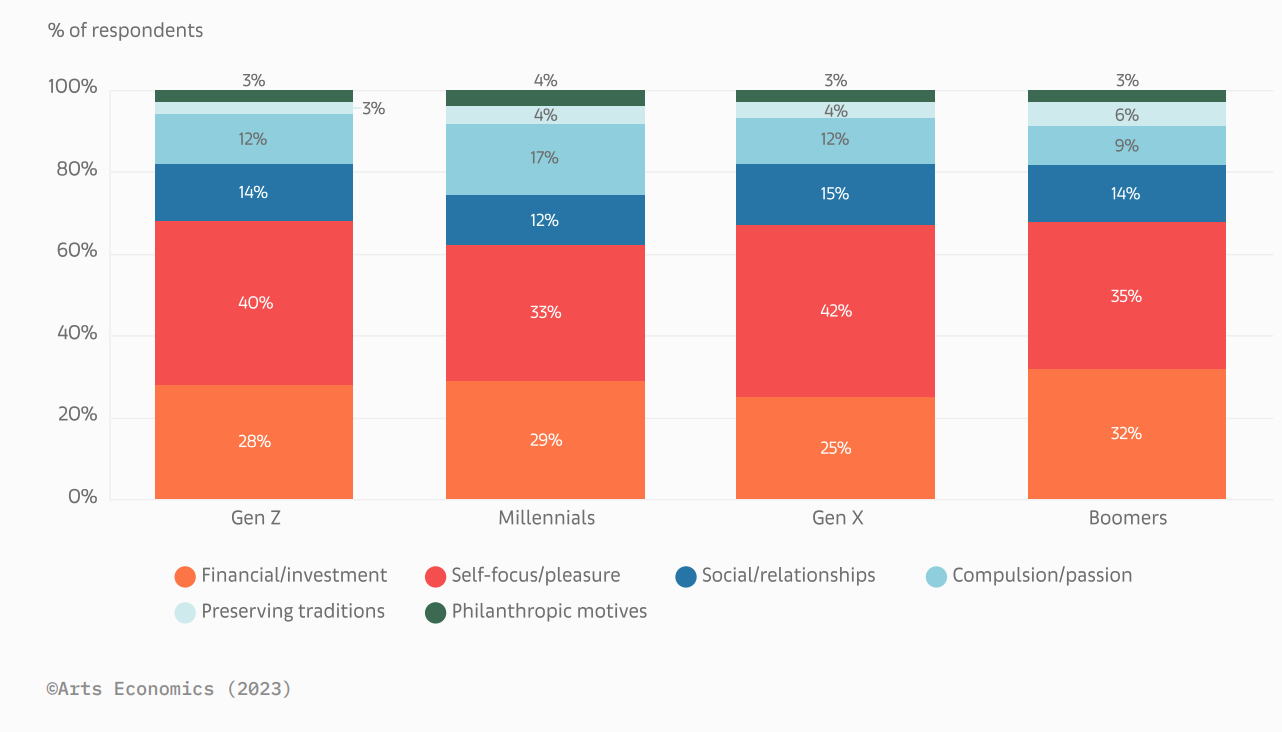
For many retail and institutional investors, there are many reasons for not seeing art as an investable asset class. One, it is extremely illiquid and has a thinly traded market. Given that art is generally seen as a collectible to keep for years, there are not many buyers and sellers constantly making transactions with each other on a daily basis. In addition, it is not the type of asset that your typical retail investor can afford to make. Art can be extremely expensive and when you factor in additional costs such as transaction costs, storage, and the purchasing of insurance, many people do not want to go through that whole process. For those who lack enough capital to build a physical art portfolio, Masterworks is the only alternative investing platform that gives investors the ability to buy fractional shares of certain art pieces. Even then, one may not be a believer that the art that Masterworks selects on its platform may generate sufficient returns, so there are selection issues that arise. Therefore, ways to invest in art is very limited and I compare this to investing in sports franchises where the only way to gain exposure is through private equity or ETFs to my knowledge. Finally, as mentioned before, with art sales reaching an estimated $65 billion in 2023, the biggest reason across generations for buying art was for enjoyment. While some do art as an attractive investment, it is generally just seen as one to fulfill one's happiness. A graph below from a 2023 Survey by UBS shows the breakdown. 


The Thesis behind Art Investing


With all this being said, those that want to invest in art are fortunate enough to take advantage of the many drivers that can make this asset extremely compelling for years to come, if one does take the time to do the research. The first are the huge age demographic changes happening across the world. Within the U.S., we are experiencing “The Great Wealth Transfer, where in the next quarter of a century, approximately $73 trillion dollars will be passed down from Boomers to Gen X, Gen Z, and Millennials. This is important due to the fact that each generation has a different taste in art. In Asia, it was noted that millennials prefer photography and installations, while Gen Z like digital art and prints. In addition, it was indicated in a CNBC article that 40% of Christie’s buyers in Asia Pacific were millennials, an important note on tracking consumer purchasing power across generations. While there is a lot of nuance that goes with understanding conspicuous consumption across generations and different regions of the world, this huge transfer of wealth from generation to generation can help investors interested in art to find the best pieces that will appreciate in value. Later in the article, I will talk about those who do enough research and have large data sets on art prices can potentially do hedonic pricing for art to help determine which pieces are most valuable as younger generations start to buy different art than their parents. The second reason is that a lot of art buying is now going digital via online art auctions, which allows for greater and easier accessibility. While some may prefer the in-person experience of bidding at an art auction, that has not stopped the online art market from growing, with CNBC reporting that it will grow to $17.76 billion by 2030, up from $9.72 billion in 2022. With more online auctions allowing for a wider audience to participate, this can potentially pump more money into the art marketplace from investors like family offices or institutional investors who may otherwise have not participated, growing the secondary market. However, online art auctions may be susceptible to trust and authenticity issues, though more research will need to be done on this to truly understand the degree to which these effects are affecting art purchase frequency.


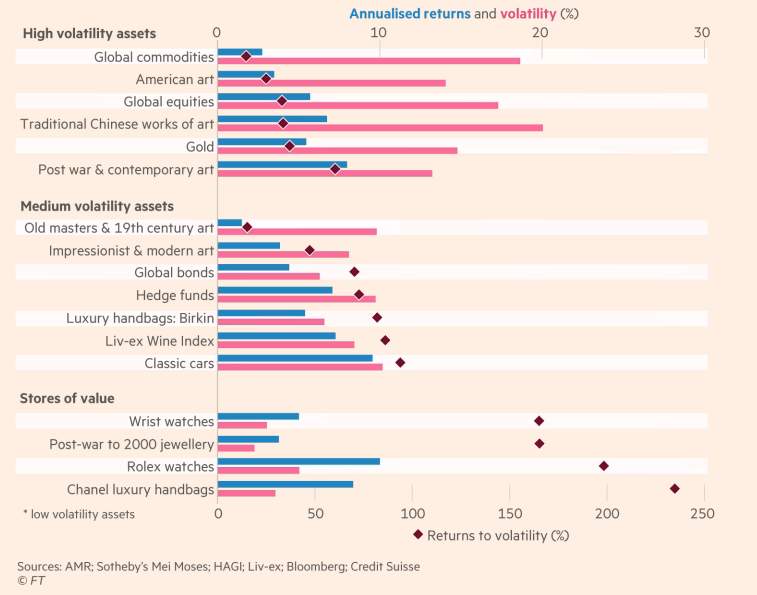
The third reason for driving art as an asset class is the rise of credit and collateral used to help finance the purchase of new art. While high interest rates have raised the cost of using credit at the moment and most people try to use current income for spending on luxury items, it was noted by UBS that 40% of high-net worth clients have used credit or collateral to help finance these art investments. Because consumers are receptive to using these means for financing these transactions, credit expansion from banks will likely continue to stimulate and grow consumer spending into this segment. Finally, which I believe is the biggest driver, art is an asset class that has a finite amount of supply. As an example, many contemporary artists from the second half of 20th century are either dead or very old that they are retired. Therefore, their famous art collections are not growing any more. But what is growing is the huge concentration of wealth being held with the top 1% of the world -- lots of economic data to showcase this. And for art, it is a type of collectible that can cater to all generations and all types of people regardless of gender or cultural background. Below is a graph that displays the annualized returns and volatility of certain collectables. 


It is very interesting to see some breakdown between different pieces of art, which supports the idea that art as a whole may not be a great investment unless you try to figure out which pieces are most valuable. Therefore, I believe certain pieces of art returns will only grow as time goes on and easily outperform the overall market. But how can we tell which ones?  


Finding the “Correct” Valuations of Art Work


For those who work at art auctions, their jobs are to sell the art, not value the art. It is really up to the buyers for understanding what is the “fair value” of a certain piece of art. But what ways can we use to determine what “fair value” really looks like? After all, there is no public valuation methodology for understanding art prices. 


First, you can look at the artistic movement from when the art was created. Is it Romanticism or Impressionism? Neoclassicism or Contemporary? This should be a great indicator of at least starting to narrow down ways to group pieces together. Then, you can do it by artist. A Picasso painting and a Banksy painting will fetch totally different prices as it not only just attracts certain types of buyers, but one is dead while the other one is still alive (hopefully) creating more art that can be purchased on the secondary market. Finally, looking at the type of art is a crucial factor, one that is possibly more relevant for anything created during the Contemporary Art period, which started late 20th century. Today, more modern artwork does not just consist of sculptures and portraits, but also digital installations, photography, and installations that people want to buy.  From here, hedonic pricing will need to be used to find the fair market value, just like what is done in real estate via the Case-Shiller index. All of these factors are just a baseline for how to look at the various ways of starting to create some valuation methodology. This will allow an art investor to figure out who is investing in what and to get ahead of trends before certain art pieces spike. Creating a database of all this data may take time, but definitely may be worthwhile for those with enough capital to seriously consider investing in art.


However, even if you can create an art database of sales that span across time periods, geographical locations, and other factors mentioned, there are still some things to consider that can affect valuations beyond what I said. One is the liquidity of the art market at a given time, which can cause deviations from expected estimates art auctions may have calculated. After all, since auctions are very infrequent, it can be hard to access the market of potential buyers. Therefore, while there are macroeconomic factors that can be used as prediction tools for whether there is a strong buyers market for art, there is still some idiosyncratic risk that comes with art transactions that can be random. Another factor is that certain art buyers may have asymmetric information sets when it comes to understanding the values of art pieces, which affects the purchase price of certain art pieces. More profit-driven art investors will do their research and fully understand the art piece before giving an offer. A more casual art investor or collector may just buy an art piece because of pure enjoyment, with the purchase price being an insignificant factor. Therefore, some types of art collectors that are not just in it for profit; some do it for identity, some feel connected to a piece due to a cultural significance, some may just be addicted to art collecting. This is why even if you can do hedonic pricing for artwork, it is important to understand art trends and consumer behavior when it comes to buying certain art pieces to fully capture the potential appreciation in value. With this being said, I do believe art as an asset class will grow in the future and see it as one of the most interesting collectables to look at.


Thank you for reading my article on art investing!


Updated as of March 14, 2024

Highly recommend people read The Art Basel & UBS Global Art Market Report 2024 for more information, which I did not cover.


Sources

Ann, Quek Jie. “Asia’s Young and Wealthy Are Fueling Demand for Art - What Are They Collecting?” CNBC, CNBC, 7 Jan. 2024, www.cnbc.com/2024/01/08/asias-young-and-rich-are-fueling-art-demand-what-are-they-collecting.html.

The Art Basel and UBS Survey of Global Collecting in 2023, theartmarket.artbasel.com/download/The-Art-Basel-and-UBS-Survey-of-Global-Collecting-in-2023.pdf. Accessed 2 Mar. 2024.

Belinchón, Fernando. “Investing in Art: A Profitable Activity Just for a Select Few?” EL PAÍS English, 12 Nov. 2023, english.elpais.com/economy-and-business/2023-11-12/investing-in-art-a-profitable-activity-just-for-a-select-few.html%C2%A0.

Masterworks. “A Short History of Art Investing.” Masterworks, 29 June 2022, insights.masterworks.com/alternative-investments/art-investing/a-short-history-of-art-investing/%C2%A0.

Mattei, Shanti Escalante-De. “The Great Wealth Transfer Is Encouraging Older Collectors to Sell off Their Art Collections.” ARTnews.Com, ARTnews.com, 22 Aug. 2022, www.artnews.com/art-news/news/great-wealth-transfer-art-collecting-1234637068/%C2%A0.

Wagstyl, Stefan. “The Market for Collectibles Can Be Volatile but Rewarding.” Financial Times, Financial Times, 2 Sept. 2022, www.ft.com/content/72b8a3ee-d6fe-4736-89e5-793377f1db88.


Friday, February 23, 2024

The Future of Catastrophe Bonds: The Rise of Reinsurance as a Hedge Fund Strategy


Being surrounded by business students who strive for high finance jobs, I can say anecdotally that people think working in the insurance industry is extremely boring. I would be lying to you if I did not think the same coming into freshman year of college. However, I had the opportunity to do research for a professor looking at Insurance-linked Securities (ILS) as a freshman and found there to be a lot of interesting developments happening in the industry, especially in relation to climate change. Recently having attended the ILS NYC 2024 conference, I thought it would be worthwhile to talk about this growing industry. In this article, I want to give an overview of CAT Bonds as well as give some insights about what I learned at the conference. 

The Reinsurance Industry and Cat Bonds 

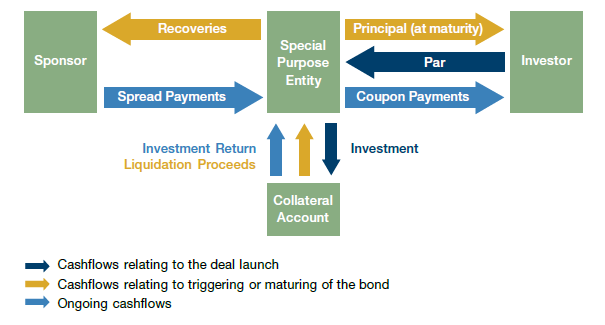
Reinsurance is insurance for insurance companies and plays a huge role in keeping the insurance industry afloat in the scenarios of large losses. But just like an insurance company, it must take care of its balance sheet and creditworthiness as it is highly sensitive to large events like climate disasters. Over the past five years, Moody’s stated that there has been on average $100 billion worth of global insured natural catastrophe losses. This has caused insurance and reinsurance companies to limit coverage or exit certain markets, with examples in the U.S being floods in Florida and wildfires in California. In addition, when costly climate disasters occur, property catastrophe reinsurance rates will substantially rise, with reinsurance companies taking on higher attachment points and aggregate covers becoming less. This will decrease the capacity of reinsurance companies as there becomes an asset-liability mismatch with perhaps their assets side being unable to cover for the large liabilities losses. Therefore, CAT bonds have been great instruments to help transfer some of this risk that reinsurance is supposed to take on to the capital markets. Below is a simple diagram from Man Group of how a CAT Bond works.    


To start, the sponsor will enter a reinsurance agreement with a SPV to collect capital from investors. This capital will then be used to issue the bond into the secondary market, where investors will be able to purchase it. A collateral account will be used to help collect the proceeds from investors and be invested in securities that have high-credit rating to ensure “guaranteed” payments. Because of this, CAT bonds do not carry any credit risk, which is attractive to insurers to know that there will never be an instance of non-payment on a claim. Now, a CAT bond can be triggered through generally two ways: indemnity or parametric. Indemnity is the most common trigger and just looks at aggregate damages done, while parametric looks into weather factors like wind speed or total amount of rainfall as the trigger. If the trigger occurs, the sponsor will be able to get the funds initially invested by investors, whether partial or full. If not, the investor gets all its principal back at the maturity of the CAT bond plus the coupon payments that come with it. 


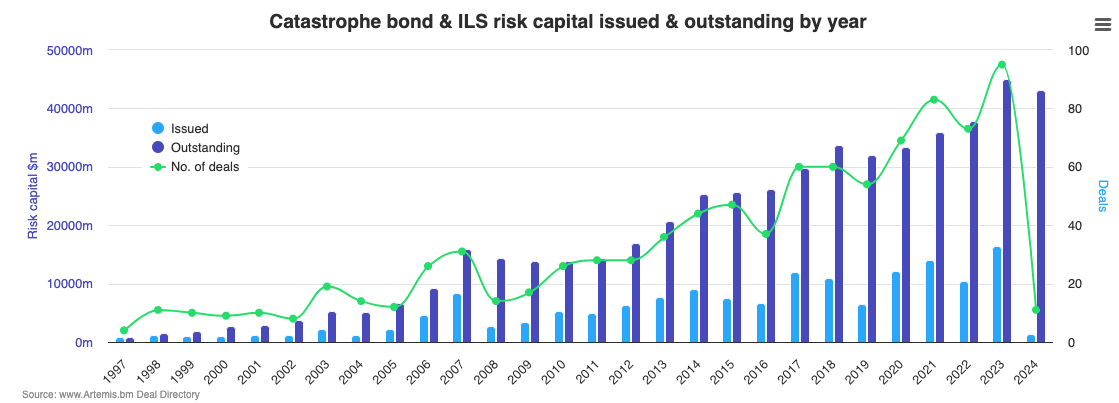
With large climate catastrophe events being very low frequency, it is important that reinsurance companies take on a long-term view of their balance sheets. If there are so few players in the space, rates will be driven down as these companies will start underwriting short-term reinsurance. But if a major event occurs, it may affect the industry’s capacity to provide sufficient coverage. This is what makes CAT bonds so interesting. Because property and casualty (P&C) insurance will inevitably grow with the frequency of climate events and the need for capacity, my thesis is that this instrument will have to grow as balance sheets of these insurance companies are constrained from a risk perspective. Sure, they may have the capacity to underwrite more, but they may have reached their max risk exposure. So far, the market growth is set to soar for CAT bonds, with an estimated $20 billion of insurance being forecasted by GAM Investments in 2024, which would be greater than the phenomenal 2023 year of Cat bond issuance. Below is a better visualization of Cat bond issuance and amount outstanding. 


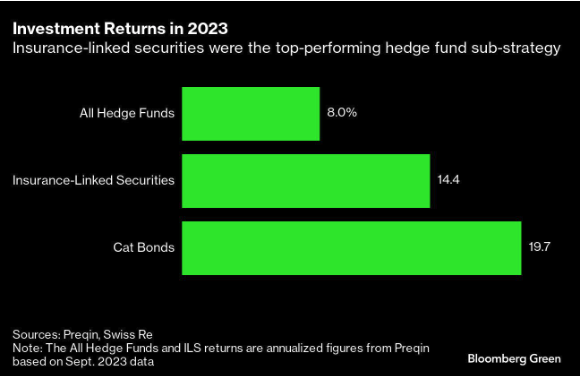
As I have been following CAT bonds since freshman year, it was a surprise to see them starting to make headlines and become more discussed within financial markets by the end of last year. For some of the top hedge funds that specialize in ILS investing like Fermat Capital Management and Leadenhall Capital Partners, it was a fantastic 2023 year for them and was spurred due to some factors like extreme weather events and high costs of rebuilding after natural disasters. Below is a graph to showcase hedge funds returns and the dominance of ILS and Cat Bonds for 2023. 

This should be illustrative of the opportunity that CAT bonds present for investors seeking  alternative sources for returns -- as an investor, you can also do pro quota treaties as well but I will not be getting into that. Not only hedge funds, but family offices and PE firms like KKR have also been catching on to how the insurance sector can provide interesting diversified, low-correlated returns relative to the overall market for its investors. If high spread levels that were seen in 2023 can be sustained, I do not see a reason for why it should not be incorporated more into investors’ portfolios. As mentioned before, has a low correlation to the overall market and compared to other fixed income products, it has very little interest rate duration risk. It will be interesting to see what occurs for the year 2024.    


NYC ILS Conference Overview


Being at the conference was quite weird, especially since I was one of only two people there who was an undergraduate student, let alone under the age of 30. However, it was definitely worth my time and I wanted to share some informative insights of what industry experts are thinking about regarding ILS securities. 


To start with Cat bonds, there were many strong remarks about the exceptional performance of the asset class in 2023, with them mentioning huge inflows of money into this instrument by opportunistic investors amidst rising interest rates. However, that is not to say that all headwinds have vanished. Many of the speakers noted that normal allocations for investors into these ILS securities are a modest amount of 1-3%, largely due to the illiquidity and scalability that comes with such a strategy. This means that despite the outperformance of many large market indices, CAT bonds will still need more than one year evidence that it can be part of investors’ portfolios. There was also recognition that ILS investors have also become more sophisticated over the years, especially given the fact that many have been following the asset class for at least a decade. Therefore, better climate risk modeling will be needed to provide evidence that capital should be given to CAT funds over pure capital strategies like equities or fixed income. So as interest rates start to fall and spreads tighten, it will be important to build transparency with investors in terms of pricing and predictability of interest-payments. Also, large left tail risk events are a reason why investors may be wary of allocating capital into these strategies, with them skeptical of climate risk modeling being done. In addition, poor asset-liability management from reinsurance companies that we saw more occur starting with the rise in the Fed Funds rate in March 2022 showed decreasing book values of these companies, meaning less underwriting and hurting the inflow of capital into CAT bonds. The final thing to note is that CAT bonds have largely been only open to institutional investors’ capital, so it will be important in the future to help retail investors obtain exposure to this growing asset class to help fill in demand. 


Despite my fascination towards Cat bonds, the most interesting topic of the conference was the Cyber bond, which is an extremely new instrument that was only introduced last year. As the world becomes more and more interconnected, cyber risk becomes an even larger problem. Cyber (re)insurers will have to serve a huge role in being able to measure the impact and frequency of these events, despite the lack of historical loss data. For 2023, there were four 144A Cyber bonds issued and will secure about $415 million in protection for those sponsors, showcasing the start of what can be an important tool for firms to minimize cyber risk. As Richard Gray of Breazley stated at the conference, there will be a need for capacity, but it is extremely important that investors are educated and confident in the cyber modeling. Because this is such a new area of expertise, despite the similarities to CAT bonds in terms of structure, indemnity traits, and catastrophic tail risk, cyber modeling companies like CyberCube must be transparent in how they think about trends. This is definitely an area worth reading about and I am starting to do more research on this instrument for perhaps future articles. 


Thank you for reading and hope you enjoyed learning a bit more about the developments happening in the insurance industry.


Sources

Evans, Steve. “Around $20bn of Catastrophe Bond Issuance Possible, Market Growth Could Soar.” Artemis.Bm - The Catastrophe Bond, Insurance Linked Securities & Investment, Reinsurance Capital, Alternative Risk Transfer and Weather Risk Management Site, 20 Feb. 2024, www.artemis.bm/news/around-20bn-catastrophe-bond-issuance-possible-market-growth-could-soar/.


Evans, Steve. “Family Offices Leaning into Insurance for Diversification. so Is KKR: Mcvey.” Artemis.Bm - The Catastrophe Bond, Insurance Linked Securities & Investment, Reinsurance Capital, Alternative Risk Transfer and Weather Risk Management Site, 13 Feb. 2024, www.artemis.bm/news/family-offices-leaning-into-insurance-for-diversification-so-is-kkr-mcvey/.


Evans, Steve. “First Cyber Cat Bonds a Watershed Moment: Moody’s RMS Video Interview.” Artemis.Bm, 30 Jan. 2024, www.artemis.bm/news/first-cyber-cat-bonds-a-watershed-moment-moodys-rms-video-interview/.


Lee, Sheryl Tian Tong, et al. “The World Being on Fire Is Swelling ‘catastrophe Bonds’ to a Record $45 Billion-and It’s a Key Hedge Fund Strategy.” Fortune, Fortune, 22 Jan. 2024, fortune.com/2024/01/21/hedge-funds-climate-change-catastrophe-bonds-disaster-insurance-record-high/.


“Property Catastrophe Reinsurance Market Dynamics to Slow in 2024.” Fitch Ratings: Credit Ratings & Analysis for Financial Markets, 23 Nov. 2023, www.fitchratings.com/research/insurance/property-catastrophe-reinsurance-market-dynamics-to-slow-in-2024-23-11-2023.


“Reinsurers Defend against Rising Tide of Natural Catastrophe Losses, for Now.” Moody’s | Better Decisions, www.moodys.com/web/en/us/about/insights/data-stories/reinsurers-mitigate-lower-profits.html. Accessed 23 Feb. 2024.


Thursday, February 15, 2024

Discount Rates and Approaches towards Valuing Climate Projects


Valuing the future can be tricky and when determining how to do so in the face of climate change, it becomes more important than ever to make sure discounting is done correctly. With that being said, valuing the long-term benefits of climate change projects has been a hot topic and thinking about tradeoffs between today and the future always brings up challenges. Using academic literature and what I learned from one of my professors, Johannes Stroebel, I want to dive into the question of how policymakers should think about discount rates.   

Discount Rates


Solving the question of discount rates is the most critical part of unlocking global climate policy and helping achieve any Net Zero by 2050 goals; therefore, it warrants a lot of attention. For the Office of Management and Budget, the Circular A-4 is an important document that helps federal agencies understand cost-benefit analysis when conducting any regulatory actions, one being project deveopment. Since 2003, the discount rate recommendation used to be 3 to 7 percent, but has recently changed to 2 percent last November. While this may not have made headlines in the WSJ or NYTimes, it is a highly important reconsideration as now federal agencies will now be able to justify more easily climate projects by showing the higher valuation that comes with projects as compared to before. While there has been some concern for how the rate was justified, it should be noted that this is now more in line with Professor Stroebel’s long-run discount rate of 2.6% for how individuals look at future benefits for very long-run outcomes of 100 years or more, which relates to climate projects. For why this lower discount rate makes more sense than the upper-bound 7 percent the OMB tried to use in the past, it is important to understand climate projects as a hedge against decreasing economic activity rather than a risky investment.     


One way of thinking about climate projects and discount rates starts with seeing climate change as a byproduct of economic output. In states of the world where the world is rich and there is high GDP growth, there is a lot of climate change. While this may not be the case for all countries as the website Our World in Data may indicate, let us still use this argument to explain the point. Climate change is seen as a tax on consumption and once consumption, hence growth, starts to eventually decrease, climate change disasters will also decrease. This makes sense when you believe that there is a strong beta between these two variables. What this means is that climate projects will only pay off if there are bad climate disasters and will not pay off in good states of the world. This can be seen as risky investment if someone thinks about it like this, which is why valuing a climate project would necessitate a high discount rate. It is when you reach that tipping point of decelerated growth when the climate project is reduced in value. 


However, there is a second approach towards thinking about discount rates with respect to climate change. In this approach, we should understand that while climate damages will increase with states of the world with high economic output, so will the probability of them occurring. If the frequency of these disasters keep on occurring, then this creates large economic risks to the country. There is this feedback loop that some people tend to miss where it is not just that economic growth affects climate change but also that climate change affects economic growth. Therefore, if climate change is the cause for decreasing economic output, that would mean that it creates bad states of the world, not good ones. When thinking about utility functions, investments always pay off more in bad states of the world than good ones. If I could earn 50 dollars in a bull economy or bear economy, making 50 dollars in a bear economy would grant me more satisfaction. Therefore, low discount rates should be used since these projects should be seen as a hedge. Climate change is ultimately creating bad states of the world and because we value things more so in those scenarios than good scenarios, applying a low discount rate makes sense. The argument of applying a high or low discount rate has been argued by policymakers and academics for years, but I believe that the second approach gives a more clear picture of why a low discount rate should be used. 


Creating Welfare Across Generations 


Therefore, If climate projects are seen as a hedge, it makes sense to start investing in them as they prove to be much more valuable than if they are thought of as a risky investment. What now needs to be solved is what method to actually discount and to make sure intergenerational equity is achieved. One way to value the future benefits of climate projects is to just apply a fixed discount rate. The biggest problem is that any future damages that may occur due to climate change have no effect on present-value terms, if applying one fixed rate. As mentioned, taking on the view that climate change exacerbates the frequency and severity of climate disasters is important to note, creating bad states of the world. However, if we just apply a single discount rate for a project over 50 years, then the discount rate being used in the present-day places no weight on future climate damages, meaning that it is undervaluing climate projects. 


There is another method where you do not even use a discount rate when finding the cost-benefit of a project because the whole idea is that we need to take on the ethical approach that every generation’s welfare deserves to be treated equally. This runs into a lot of problems. One, there is always the case that climate change wipes out all humans, so there has to be some added risk incorporated into valuing future benefits of projects. Also, when thinking about how humans make decisions, it would be foolish to think that someone cares the same amount about something happening in 50 years as something happening in 5 minutes. I do not see this as a reasonable method.


In my opinion, the use of declining discount rates should be the method of choice. By using declining discount rates, the method places large weight on the value these projects hold for the future and helps governments justify the long-term benefits for the climate. If climate change affects economic growth negatively and exponentially, this would imply that these projects become more valuable in the long-term than the short-term. This does rely on some assumptions though. The first is that this thinking only works if the world is not at a tipping point where climate change starts to reverse. The second is that change is not a tax on peoples’ consumption and people keep on consuming regardless of if the world keeps on getting worse. 


I hope you liked this article. If my thinking is flawed, please let me know as I am still trying to learn how to think about this as these were my immediate thoughts.     


Sources

Climate Change and Long-Run Discount Rates, pages.stern.nyu.edu/~jstroebe/PDF/GMRSW_Climate.pdf. Accessed 10 Feb. 2024.


Hepburn, Cameron. Valuing the Far-off Future: Discounting and Its Alternatives, www.lse.ac.uk/GranthamInstitute/wp-content/uploads/2014/02/discount-rates-climate-change-policy.pdf. Accessed 10 Feb. 2024.


Morgan, Elena. “Climate Change, Discounting, and the Tragedy of Horizons - News & Insight.” Cambridge Judge Business School, 11 July 2022, www.jbs.cam.ac.uk/2021/climate-change-discounting-tragedy-of-horizons/.


Ritchie, Hannah, and Max Roser. “Many Countries Have Decoupled Economic Growth from CO2 Emissions, Even If We Take Offshored Production into Account.” Our World in Data, 28 Dec. 2023, ourworldindata.org/co2-gdp-decoupling.


Stuart Shapiro, opinion contributor. “OMB Just Did Something Boring but Important.” The Hill, The Hill, 28 Nov. 2023, thehill.com/opinion/finance/4329892-omb-just-did-something-boring-but-important/.

Thursday, February 8, 2024

The U.S. Solar Tariff Conundrum: Examining the Business Case for Chinese Solar Panels

File:Solar Energy Roof Solar Power Generation 2666770 CC0.jpg - Wikimedia  Commons

Last month, global leaders at COP28 made a historic agreement by stating to make the ‘transition away’ from fossil fuels to meet long-term climate goals. Therefore, the role that renewable energy will play in helping decarbonize the world is vital. For the United States, Joe Biden has enacted several key legislations so far in his time as president such as the Inflation Reduction Act and the CHIPS and Science Act to help revitalize domestic manufacturing and spur growth in clean energy. While these pieces of legislation are crucial for speeding up decarbonization efforts in the United States, with one study from Princeton saying that the Inflation Reduction Act (IRA) will cut carbon emissions by double now in the U.S. from 2% to 4%, it is hard to see how United States clean energy manufacturing will be competitive with that of China, with one example being creating solar panels. China has been making solar panels cheaper and at a larger scale than the United States for over a decade, but that does not seem to have stopped the imposition of tariffs on them to help reshore manufacturing operations. As projections state that the U.S. electricity supply will be more than 50% solar energy by the year 2050, the U.S. is grappling with a huge question for how to go about competing in solar with China. In this article, I will examine U.S. solar manufacturing compared with China and the predicament that the United States faces in balancing geopolitical and economic interests. 

The Problem with U.S. Solar Manufacturing  


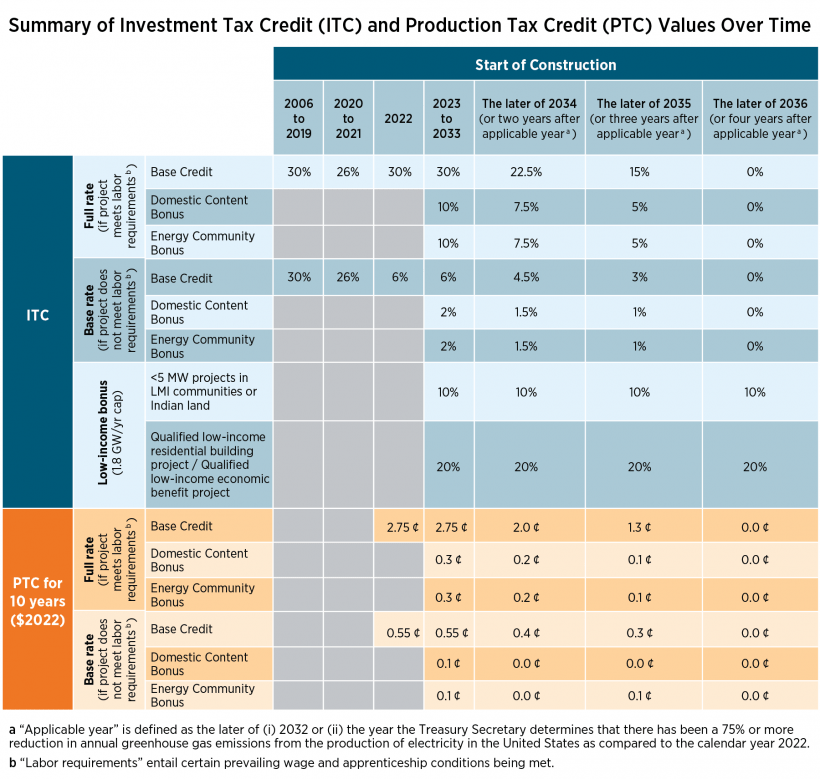
There are lots of reasons for why to reignite solar manufacturing in the United States. For one, it is apparent that there is growing demand for solar energy as it made up more than 48% of new additions of electric generating capacity, helping grow the cumulative U.S. installed solar capacity to more than 162 gigawatts. In addition, the industry is a huge employer of jobs as there were more than 263,000 Americans working in solar in 2022 alone. This figure will likely increase due to a strong regulatory environment with the passage of legislation like the IRA that incentivize building facilities and domestic-sourcing of parts. For example, this is a table taken from the Department of Energy to show solar tax credits.

Given that solar requires very low operating costs, the Investment Tax Credit has been overwhelmingly popular given that there are huge upfront capital needed for solar -- a change in to a Republican administration like Trump may also revoke these tax credits potentially as well so opting for the Production Tax Credit may be risky. Finally, a paper by Cornell professors found out that reshoring solar manufacturing will lead to 33% lower emissions and 17% lower energy use by the year 2050. So in that sense, it is a win-win situation where you help create more jobs in the solar industry as well as reduce your carbon footprint. I know that there is the geopolitical side to the equation, which I believe is what this whole thing is about, but I will talk about that later in the articles. Though even when taking into account these tailwinds, when thinking about competition from purely a business standpoint, the solar tariffs that are being imposed on China do not make sense at all.


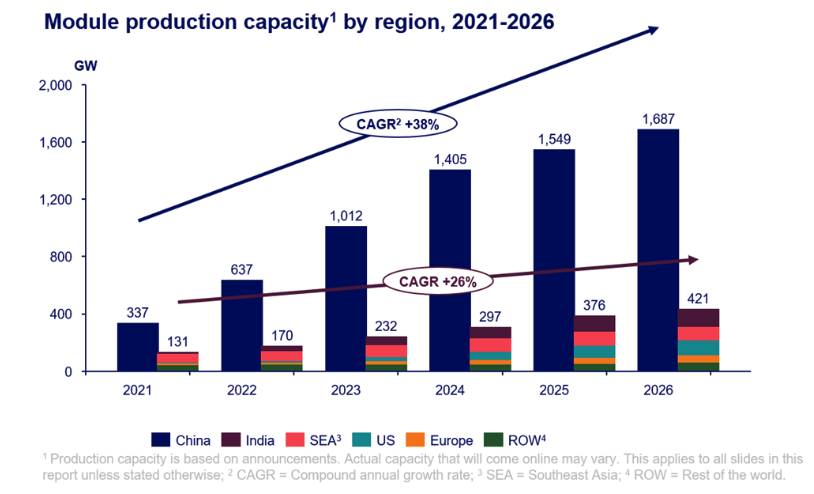
According to Wood Mackenzie, China’s module production capacity will be able to meet annual global demand starting in 2024 through 2032, with it controlling over 80% of all the polysilicon, wafer, cell, and module manufacturing in the world. Below is a graph to visualize the data.

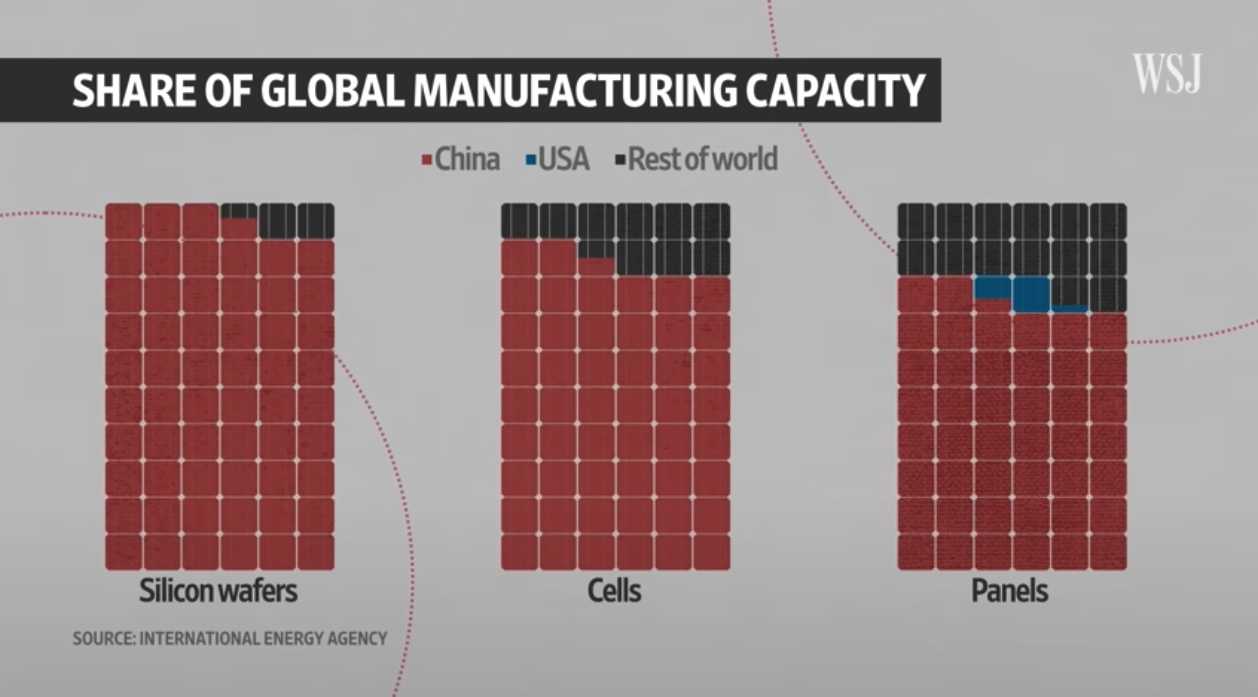
When looking at just module production capacity projections, the United States only represents a small percentage of that part of the supply chain. While there are multiple reasons to point to, one of the biggest reasons is that it still needs to import a vast majority of the modules, wafers and cells from other parts of the world. The Solar Energy Industries Association reports that about 42 gigawatts of solar panels will be produced using domestically sourced parts, a modest number compared to what China is able to do already. The number indicates the reliance U.S. solar manufacturers still have on other countries for raw materials and parts, with China being the biggest one; however, there have been efforts to reduce these imports. For example, McKinsey reports that while China has about 79% of the world’s polysilicon capacity, companies like CubicPV have been looking elsewhere like in Malaysia to try to reduce reliance on China for creating wafers and cells. But even then, when just looking at the global share of manufacturing when it comes to wafers, cells and panels, the United States just does not even have the facilities to even start competing with China. In a Wall Street Journal video I watched recently, I came across this infographic that explains my point.

There are few facilities in the United States to manufacture the wafers and cells and for modules, First Solar is the only U.S. manufacturer to crack the top 10 in solar capacity produced -- China holds 7 of those 10 spots. That is not to say that the U.S. is not increasing manufacturing facilities for these parts, but it will not reach the scale that China is able to do so. While huge subsidies and tax credits over the years can be credited for the rise of Chinese solar, it would be foolish to ignore the global value chain for solar panels to explain the country’s dominance in the industry. As mentioned previously, many Chinese solar producers are already vertically integrated and have the materials necessary to design solar panels without dependency on the United States. If you look at semiconductors, the U.S. produces nearly 50% of the world’s semiconductors and China relies a lot on it to help it with its advanced technology development. Therefore, the Trump and Biden administrations have been able to leverage its dominant position over China to add Chinese technology companies like Huawei to the Entity List and reduce the types of semiconductors China can get. For solar panels, this is just not the case and the U.S. does not seem to have the luxury of trying to incentivize domestic content and production of solar panels.


Then, there is the cost issue that solar panels in the U.S. face. The cost to produce solar panels in China is at 15 cents per watt, a huge discount compared to the 40 cents per watt it takes for the United States to do the same. What is worse is that the U.S. price may only be increasing, according to a recent ruling. A report by the U.S. Department of Commerce stating that China has done so by moving some operations elsewhere in Southeast Asian countries like Thailand and Cambodia. Joe Biden, however, has exempted a challenge by US panel manufacturers to reinstate tariffs until June of this year, an indication that there is recognition that sourcing raw materials and parts from China is still needed. Once the import tariffs on solar modules from these countries are in place again, prices in the United States will only increase. This also does not take into account the cheap (or forced) labor being done in the Xinjiang province of China, where studies show workers working for less than $2.50 an hour. Other places like Europe are facing an even greater crisis than the U.S. as solar producers have called for Brussel to quickly act against China before potential bankruptcies may occur to solar manufacturers.


The Economic Reality 


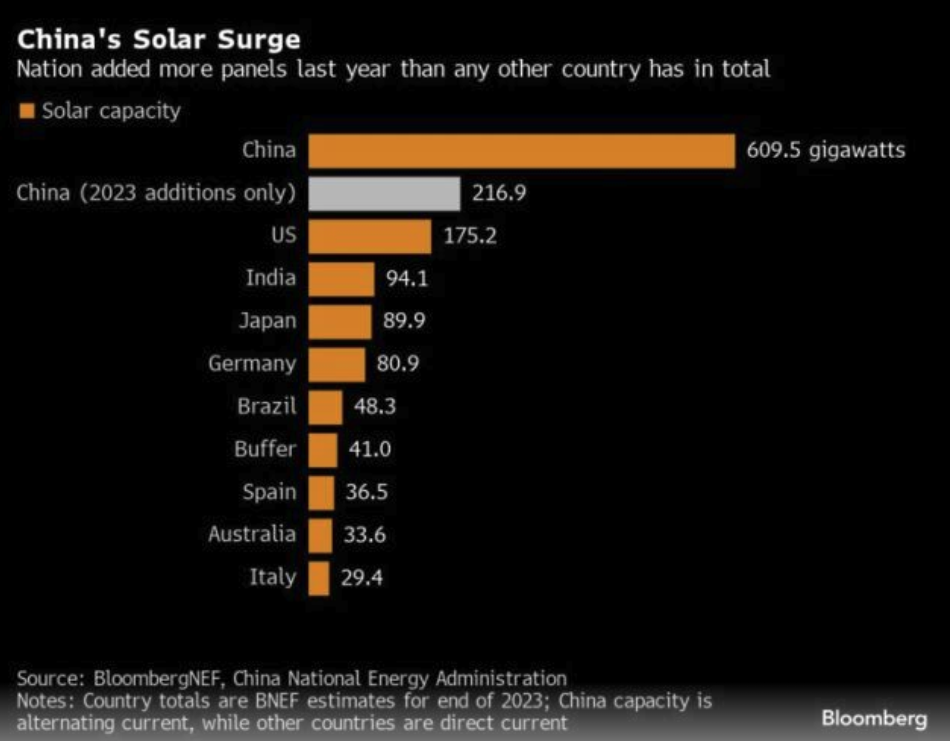
While the economics of solar manufacturing in the United States and the tariffs do not seem to make sense, there is at least the argument of energy security that grants attention, which presents the best reasoning for action in my opinion. The U.S. Department of Defense has stated in the past that the U.S. should “not surrender clean energy technology” when discussing China. There is strong rationale for challenging China’s monopoly on solar as the United States does not want the good to be used as leverage in trade negotiations and export controls. The United States may have learned a lesson with what happened to Europe with its dependency on Russian gas. But to me, it all comes back to cost and scale, which the U.S. simply can not compete on. To point to one final graph, this was recently reported by Bloomberg and shows how China’s solar panel production in 2023 is greater than the U.S. entire solar capacity.

I find this to be an astounding achievement and one that I will continue to emphasize against strengthening U.S. manufacturing for solar. While there is huge political pressure from policymakers -- senators Ossoff, Warnock, Rubio and Brown have urged Biden to increase tariffs recently -- and U.S. solar manufacturers to keep up with incentives and embrace domestic manufacturing to protect jobs and counter China, it is also important to make government decisions that allocate capital efficiently. China already has a monopoly on the global solar energy market and it does not seem reasonable to keep on competing, especially if the United States is serious about meeting its renewable energy targets. Ultimately, I find this a battle that the U.S. may just lose, but only time will tell to see the true outcomes.


Sources

Bounds, Andy, and Alice Hancock. Brussels Considers Support for Solar Panel Makers as Chinese Imports Flood Market, 27 Jan. 2024, www.ft.com/content/39af71b4-36dc-4bb9-a181-3710fdfb7ac2.

China Solar Panel Costs Drop 42% from Year Ago - Report, 14 Dec. 2023, www.reuters.com/world/china/china-solar-panel-costs-drop-42-year-ago-report-2023-12-14/.

“China to Hold over 80% of Global Solar Manufacturing Capacity from 2023-26.” Wood Mackenzie, 7 Nov. 2023, www.woodmac.com/press-releases/china-dominance-on-global-solar-supply-chain/.

DeWeerdt, Sarah. “Reshoring Solar Panel Production Cuts It’s Carbon Footprint.” Anthropocene, 21 Mar. 2023, www.anthropocenemagazine.org/2023/03/how-reshoring-solar-panel-production-could-help-the-u-s-meet-its-climate-goals/.

Dlouhy, Jennifer A. “Biden Solar-Tariff Holiday Challenged, Adding New Industry Risk.” Bloomberg.Com, Bloomberg, 4 Jan. 2024, www.bloomberg.com/news/articles/2024-01-04/biden-solar-tariff-holiday-challenged-adding-new-industry-risk.

EIA Projects That Renewable Generation Will Supply 44% of U.S. Electricity by 2050 - U.S. Energy Information Administration (EIA), www.eia.gov/todayinenergy/detail.php?id=51698. Accessed 31 Jan. 2024.

Low Wages in the Chinese Solar Industry – CMHI, www.cmhi.com.hk/low-wages-in-the-chinese-solar-industry/. Accessed 31 Jan. 2024.

Manufacturing Reniassance Report 2023, www.seia.org/sites/default/files/2023-03/Manufacturing%20Reniassance%20Report%203-8-2023.pdf. Accessed 31 Jan. 2024.

Pickerel, Kelly. “CUBICPV Plans to Use Malaysian Polysilicon at Its Potential U.S. Wafer Factory.” Solar Power World, 18 Dec. 2023, www.solarpowerworldonline.com/2023/12/cubicpv-plans-to-use-malaysian-polysilicon-at-its-potential-u-s-wafer-factory/.

Seltzer, Molly. “New Study Evaluates the Climate Impact of the IRA | Corporate Engagement & Foundation Relations.” Princeton University, The Trustees of Princeton University, 12 July 2023, partnerships.princeton.edu/news/2023/new-study-evaluates-climate-impact-ira.

“Solar Industry Research Data.” SEIA, www.seia.org/solar-industry-research-data. Accessed 31 Jan. 2024.

Vergun, David. “U.S. Should Not Surrender Clean Energy Technology to China, DOD Official Says.” U.S. Department of Defense, 25 Aug. 2022, www.defense.gov/News/News-Stories/Article/Article/3140223/us-should-not-surrender-clean-energy-technology-to-china-dod-official-says/.

Update

I have been busy with finals, but will post more cool articles like an analysis on the evolving problematic monetization schemes in video ga...